
Ben Lomond - Southern Escarpment
 1 hour +
 Morning sun
 Alpine dolerite, less regular than the northern escarpment
Acknowledgement
Based on an original guide by Garn Cooper
Introduction
To the east of Launceston is the great bulk of the Ben Lomond Massif, a high plateau capped by a layer of Jurassic dolerite. At the southern end of the plateau is a long escarpment terminating in a mighty corner pillar rising up to 1527m, Stacks Bluff. This southern rim to Ben Lomond is a line of huge dolerite cliffs, forming one of the finest mountain landscapes in Tasmania, with spectacular views from the top - Mt Wellington is clearly visible on a good day far to the south.
The cliffs on Ben Lomond are at present no bolt zone. Here, this presents a different proposition to the Northern Escarpment, as the lines of the Southern Escarpment are less continuous and yield far fewer safe, traditionally protected lines. While bolts and pitons were used in early attempts to pioneer new lines at Stacks, these have been removed and a headpoint ethic now exists for the cliff. It's something novel for Australia and many opinionated mainlanders and Tasmanians alike enjoy the idea of this experiment. Despite this, only Aqualung, Maxalon and Overhanging like a Sausage receive much traffic and the headier lines are filthy and require a thorough clean before repeat ascents anyway. Given this, the headpoint ethic is perhaps not such a loss to those who prefer to climb ground-up as it seems.
In the future this situation may change and it should be considered an open topic for discussion (consensus climbing ethics aren't, after all, carved in stone). In the meantime please respect the current no-bolt status and remember to do your research before approaching any of the harder lines ground up.
History
Many of the higher cliffs in Tasmania pose major challenges to climbers seeking new routes. Difficult access, complex route finding, variable weather, steepness and sometimes loose rock, all combine to make any climb a major undertaking. Yet each new generation has some climbers who are attracted to the mountains by those very difficulties, the innovators who not only push grades but also move out into new areas, explore the possible and give the improbable a shake as well. And so it has been at Stacks Bluff.
It wasn’t until the early 1970s that the first recorded rock climb was made when the redoubtable Reg Williams and Lyle Closs climbed Brunhilde (16) on Rhine Buttress, with Bob Bull and John Moore adding two more lines a month later. The early pioneers from that time reads like a “Who’s Who” of Tasmanian, and Australian, climbing. Peter Jackson, Kim Carrigan, Ian Lewis, Bryan Kennedy, Bob McMahon, with Williams and Closs, between them established many of what are now recognized as the classics of the area. In 1973, this culminated in the ascent over three days of the “Trinity” (Aqualung (21), Blue Eyed Son (18) and No Blind (19)) by Closs, Lewis and Kennedy on Denison Crag, serious, long and committing climbs which have maintained their grade to today. Not content with these classics, Lewis returned with Carrigan two weeks later to add Maggie May (21) and Overhanging like a Sausage (19) to the tally.
Exploratory trips by John Burgess, Mike Douglas, Mick Steane and Chris Viney in the late 1970s opened up new faces and climbed the prominent summit ridges, but Carrigan with a youthful local boy, Simon Parsons, was back in ’82 to add the classic Maxalon (23).
Activity subsided for some years. McMahon and Robert Staszewski put up Visiting Earth (21M1) in the mid 90s, before Garn Cooper became enthused by the cliff and its potential. Over the next couple of years he repeated many of the classics and added a number of classy climbs of his own such as the South Side of the Sausage (20) with Hamish Jackson, and The Definitive Article (17) on Rhine Buttress with Bruce Terry. McMahon was back in 1997 with Norm Selby on Ulster (18), but it was Al Williams, climbing some 30 years after his father, Reg, pioneered the first climb in the area, who led the next push with Doug Grubert and Cooper on such classics as Hybrid Vigour (21) and the Wall (19). The Tasmanian Climbing chronicler, Gerry Narkowicz has added to his tally for the mountain with Cornercopia (23), climbed with Gareth Llewellin, and most recently, in 2008, Kim Robinson and Claire Hewer have breached the Baleen with two more quality lines. There is still a phenomenal amount of rock awaiting the next generation of ambitious and restless climbers.
The southern escarpment is also an important ice climbing area and a short guide to Ben Lomond has been prepared by Peter Booth.
Access
Traveling from Hobart or Launceston on the Midland Highway, turn east on the A4, just south of Conara Junction, and head for Fingal. At Avoca turn L and drive up the B42 to Rossarden, and then about another 6km on to the abandoned tungsten mining township of Storys Creek.
Alternatively if traveling up from the east coast, follow the A4 to St Marys. Continue towards Fingal but turn off R on the B42 through Mangana and onwards towards Rossarden. After about 20kms, take the turn off R to Storys Creek.
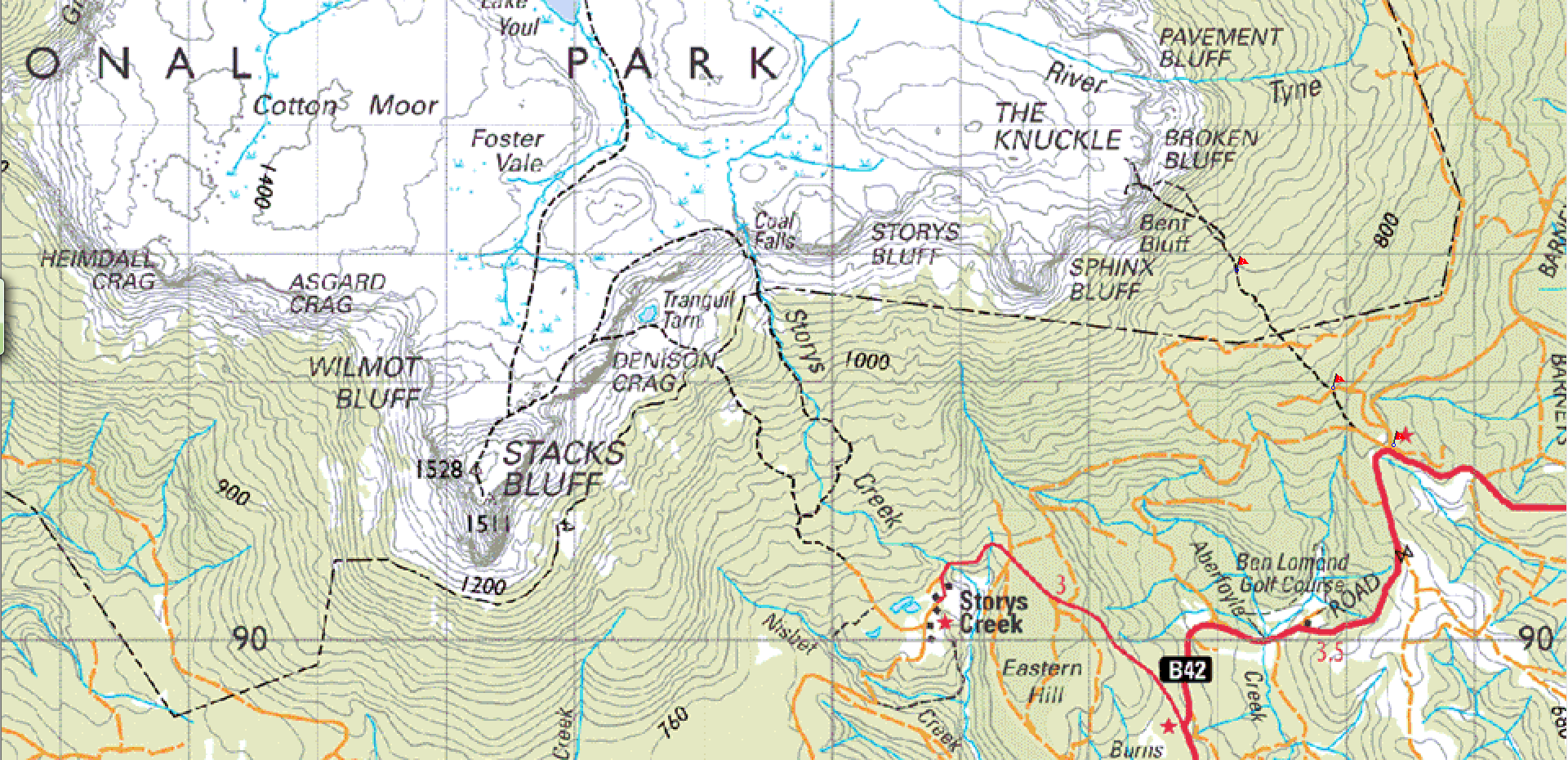
The road for Stacks starts from the far end of township, about 100m past the old hall on the R. The turn is sign-posted by a blank sign. It heads up towards the mountains for about 1.5km. There a cairn marks the turn off to the right on an older track. Not far up this is a spot with ample parking and room to turn around at a track junction. Best to leave your car here and walk, unless you have a 4WD, in which case you can drive on further up the LH track, saving maybe 25 mins walking.
From the end of the 4WD drive track follow the cairns and red tags up and out of the bush to the base of the talus slope, about half an hour's walking. Continue across the blocks towards the base of Denison Crag.
Camping and backpacker accommodation are available at St Marys, or you may opt for the great campsite by Tranquil Tarn, located a couple of hundred metres east of the marked track below Denison Crag. (See Tasmap St Pauls, 1:100 000 or Stacks 1:25 000 [5439] ). Alternatively the newly opened Craggy Peaks resort has upmarket accommodation at Rossarden (www.craggypeaks.com.au).
The area is within the Ben Lomond National Park and is a fuel stove only area. A Parks Entry Pass is required.
Climbing Info
The walk-in takes only about one hour from the road head but the cliffs of Stacks Bluff are exposed and high, rising up to 1500m, and inevitably catch the prevailing weather. In winter the crag is often ice covered, while in summer changes in conditions can be rapid and unexpected. The climbing is fairly typical for dolerite, with steep and strenuous cracks interspersed by walls and corners, broken up by welcome ledges. The longer routes are up to 200m making them a serious undertaking. This is a bolt-free crag and the consensus seems to be that it should stay that way. Please respect the local opinion on this one. There are four main cliffs in this area. To the L (west) is Stacks Bluff itself, with a series of ridges leading to the summit, then the columnar cliff called the Baleen. The Blade Crag is next, followed by the impressive Denison Crag to the R, the most popular to date and most accessible. For more information and additional topos, see “Climb Tasmania, A Selected Best Guide” by Narkowicz 2005, and "Memory of a Journey" by McMahon & Narkowicz 2008.
Crag Steward
Rock climbers please contact the Cliff Steward (benlomond@climbersclubtas.org.au) if you have any queries or concerns regarding social or environmental impacts of rock climbing at this crag. Do not email regarding general travel, seasonal advice, or lost property - this is not the Steward’s role. If you have important safety information to communicate (e.g. risks due to recent and large rock falls) please also consider updates on thesarvo forum, facebook group and/or online guidebooks as appropriate. Please copy in cct@climbersclubtas.org.au if you feel you have a high level concern which may imminently impact the crag or climbing community.
Non-climbers, other users, land managers: please also contact cct@climbersclubtas.org.au if you have important climbing related queries at this location.
GPS
Africa
Africa is a series of massive (up to 200m) and isolated cliffs on the south western edge of the plateau. It's about a two and a half hour walk via Stacks Bluff. There are 31 routes described in the 2008 McMahon & Narkowicz guide.
The following routes are updates to the 2008 guide.
Ragnarock
140m22Stacks Bluff - Summit Ridges
There are three big ridges terminating near the summit of Stacks Bluff. Quite a hike and a big adventurous day.
Typhoon Ridge
★240m14"A ridge where you need a hemp rope, a couple of no. 1 slings, and one or two ex-W.D. krabs. Great rock, climbing, positions, and nearly all the climbing is easy, a bomber of a route." Start: At the far southwest corner of Stacks Bluff there is a series of six or seven ridges leading up to the top of the mountain. Typhoon Ridge is very broken at the start and is the last one before you start heading uphill on a traverse from the lake under the cliffs. The first two pitches were on rather bad rock but the quality improves radically. The hardest pitch was when the route went out left over a freshly cut bit of rock and up a rather bare area. Another bit is where the route goes to the right of the ridge and up thin cracks to the top of the ridge again. Apart from these, the route is plain sailing, especially when the wind is doing 70 - 80 mph.
Lyle Closs, Bryan (Hooks) Kennedy (alt) 25 Dec 1973.
Hagen Ridge
★280mStraight ForwardMike Douglas, Chris Viney Mar 1975.
South East Ridge
★240m13This is the eastern most of the three main ridges on the southern end of the bluff, and joins Hagen Ridge (the central of the three) after about 150m. Another real bomber. Start: The route starts a few yards right of the base of the ridge and follows an obvious left trending line for about 70m to the crest of the ridge. Here there are two huge chimneys; the left hand one leads back up to the ridge crest, and from here a crack goes straight up to the skyline to the first pinnacle before the junction with Hagen Ridge (150m). From here a short abseil and traverse lead to a narrow chimney at the top of the grass pitch of Hagen Ridge, ie up chimney, exit out back of Fafnir's Chasm, up crack at left of skyline, along skyline and across slabs to exit cracks (240m).
John Burgess, Mick Steane (alt) 7 Dec 1976.
NB: Instead of traversing left at the junction with Hagen Ridge, an idea would be to go straight up the crack which splits the wall ahead (serious) or else there are some big lines on the east wall; an attempt on one of these was thwarted by an uncooperative tree. These cracks would probably come out above Fafnir's Chasm.
The Baleen
This is the very regular columnar cliff between Blade Crag and the top of Stacks. It is probably best to walk to the top of this cliff, dump your gear, and abseil down the gully between the western and the middle buttresses. The bottom access is quicker but scrubbier.
Between The Eyes
145m18Bruce Terry, Garn Cooper, 2 Dec 2000.
First In Best Dressed
★★70m17G.Cooper, A.Bown 7 Dec 2000.
Being Krill
★★70m19A. Bown, G.Cooper 7 Dec 2000.
The next two routes are located just to the right of the large pedestal in the center of the Baleen. They start on a ramp 5m up from the base of the wall and are easiest to access from the top. Located at the top in the middle of the cliffs length is a large cairn. To access theses climbs abseil down just to the east of the cairn.
Humpback
★★59m20Kim Robinson, Claire Hewer, Mar 2008.
Minke
★★61m22Kim Robinson, Claire Hewer, Mar 2008.
Cornercopia
★★60m23Start: At the RH end of the middle Baleen buttress, this is the most obvious protectable line. It ascends a broken crack in a corner, then at mid-height moves L with the broken crack, into the next corner until the top.
Gareth Llewellin, Gerry Narcowicz 2006.
Blade Crag (Upper Tier)
Icing Legitimate
35m14R. Bull, J. Moore (alt) Easter 1971.
Blade Crag (Lower Tier)
Windhover
65m15P.Jackson, R.Williams, 1971
Schinken
70m14Lyle Closs, Robert McMahon 1971.
Hydatids
50m15R. Bull, J. Moore (alt) Easter 1971.
Denison Crag
Ach!
An obvious line on the far left hand end of Denison Crag, facing across the gully to Blade Crag. One pitch - a grunt of a climb, best defined by its name.
Lyle Closs, Bob McMahon early 1971.
The Easter Island Bunny
10m19At the top of the western descent gully is a lone pillar which resembles a rabbit. Climb the easiest line on superbly solid rock.
Alan Williams (solo) 6 Dec 2000.
The next routes are just left of Lucifer.
Vogelsang
70m19Corner crack around left of Sky Mark, with a bush one third the way up.
Robert McMahon, Mick Ling 1997.
Sky Mark
70m18Doug Grubert, Alan Williams (solo) 6 Dec 2000.
The Wall
★★50m19Alan Williams, Doug Grubert 6 Dec 2000.
Lucifer
80m13John Burgess, Michael Steane (alt) 30 Nov 1975.
Molly Bloom
80m17Prominent crack R of Lucifer.
Robert McMahon, Robert Staszewski 1997.
Buck Mulligan
83m17Next crack line R of Molly Bloom, move L at 15m.
Robert McMahon, Norm Selby, 1997.
Next Of Kin
100m15Between Overhanging Like A Sausage and its descent gully are two large chimney/gullies. This route is the left facing corner between the these two gullies. It has a white spot about 30m on the right and a big roof at about 40m, which you can pass easily on the left. After the roof, stick to the broad arete on the right, passing up a little (3m) detached pillar which leans over the chasm on the right.
Garn Cooper 30 Nov 2000.
Puff The Magic Dragon
100m22Alan Williams, Doug Grubert, 5 Dec 2000.
Scimitar Buttress
The leftmost major buttress on Denison Crag (aka Nibelung Walls) is called Scimitar Buttress (and Rudiger's Castle).
The South Side Of The Sausage
★★125m20Garn Cooper, Hamish Jackson, Jan 1999.
Overhanging Like A Sausage
★★★175m19Kim Carrigan, Ian Lewis (alt) 12 Jan 1974.
On the butrress R of OLAS is:
Idiot Savant
200m19Corner system on recessed buttressed R of Overhanging Like a Sausage.
R. McMahon, P. Hensley, 1998.
Right of Scimitar Buttress a prominent tower stands out from the cliff about 3/4 of the way up it. A route called Danube Buttress by Whelan, Prins and Lawson starts below this and finishes up to the right of it?
The next major buttress to the right is called Saxon Spur and was possibly climbed by Douglas and Whelan.
Rhine Buttress
And the next is called Rhine Buttress.
Double Edged Sword
~100m20A route left of Brunhilde which finishes on top of the same buttress. Start 15m L of Brunhilde at chockstone filled crack. Descend on left by abseil.
G.Narcowicz & R.McMahon mid 1990s.
Brunhilde
115m16Lyle Closs, Reg Williams (Alt) 6 Mar 1971.
The Definite Article
★★140m17Bruce Terry, Garn Cooper, 11 Jan 2003.
Brownian Motion
170m19On second buttress L of Trinity between Definite Article and Thackery.
Robert McMahon, John Fisher 1997.
Thackeray
170m16John Burgess, Michael Steane (varied leads) 11 Dec 1977. An old abseil sling was found just above the roof on the second pitch.
Chaos
170m19A wandering line up face R of Thackery and finishes up scrubby gully.
Norm Selby, Bill Chilvers, 1997.
The Trinity
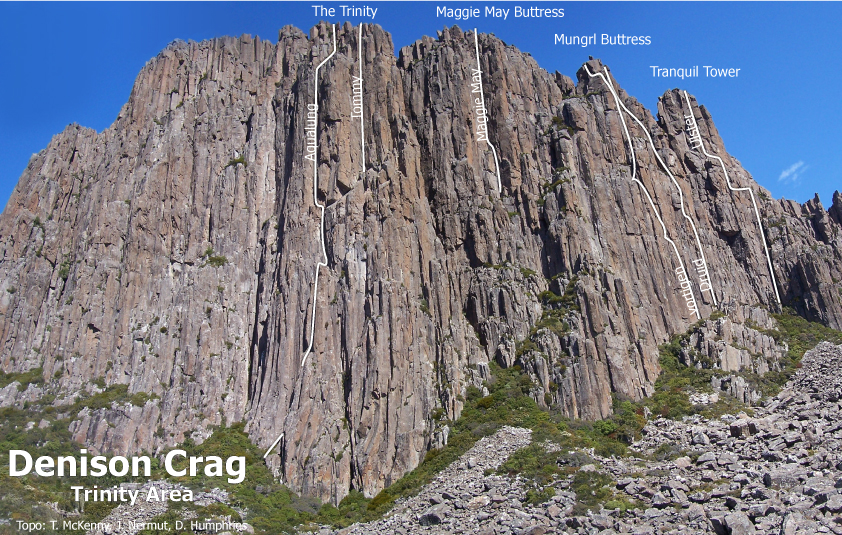
This is the most impressive part of Denison Crag, and one of the more impressive chunks of dolerite in the entire state.
No Blind
★★190m19Lyle Closs, Ian Lewis (alt), 27 Dec 1973.
Blue Eyed Son
★★165m18Ian Lewis, Lyle Closs (alt, sort of) 26 Dec 1973.
Trinity Split
24The Trinity Split (24) goes direct up the face L of Aqualung and R of Blue Eyed Son. Four pitches, 22, 24, 23 and 19, involving spectacular face climbing in some very runout situations.
The first pitch takes adequate gear and can be climbed as an appealing single pitch excursion from the ground. Descent is from the slung horn beley. A 30 m rap will get you to Aqualung Pitch 1 tat-station or 55 m rap to the ground, or traverse into Aqualung and continue up that.
Gerry Narkowicz and Pat Butler, 2012.
Aqualung
★★★175m21Ian Lewis, Bryan Kennedy, 28 Dec 1973.
Tommy
★★190m16L. Closs, I. Lewis, Feb 1973.
Brave New World
★★★23RNamed after a book where things are a bit less inclusive and wholesome than your overlords would have you believe. Could be either fitting, or ironic!
Two independent pitches, branching off from Aqualung at the second belay for that route, following the very appealing line of shallow corners, rooflets and flakes to rejoin Aqualung after its fourth pitch. Protection is adequate apart from a 12 meter runout section of grade 19, with a few loose blocks. The money pitch is 55 m and can be rap inspected (or top roped) from an anchor 5 m to the right of Aqualung's fourth belay.
Visiting Earth
21M1The Ridge Right Of Tommy was climbed by Stazewski and McMahon in 1995, with a touch of aid.
Maggie May Buttress
Hybrid Vigour
★★★90m21(aka Palm of Pleasure)Alan Williams, Garn Cooper 1 Dec 2000.
Maxolon
★★★100m23The corner on left wall of Maggie May. Pitch 1 as per MM but belay 3 m to the left. Up the searing corner crack, through rooflet, and stick in there for the pumpy and sustained wide finger crack above. A sensational pitch -- perhaps one of Tasmania's best cracks.
Simon Parsons, Kim Carrigan Mar 1982.
Maggie May
★★★100m21Kim Carrigan, Ian Lewis (varied leads) 13 Jan 1974.
Sentimental Nonsense
100m20Two pitches of hand to offwidth cracks up the right wall of Maggie May.
Kim Carrigan, Simon Parsons, 1982.
Mungrl Buttress
Mungrl Buttress (aka Wizard Buttress) is the buttress between Maggie May Buttress and Tranquil Tower. The first route is to the left of Druid.
Vortigern
★145m19O Gervasoni, T Kohl, 10 Feb 2008.
Druid
150m16I. Lewis, L. Closs Feb 1973.
Tranquil Tower
The northeastern most part of Denison crag.
Blue Lake
80m14Basil Rathbone, John Burgess 27 Jan 1980
Ulster
★110m17Robert McMahon, Norm Selby (alt) 1997. Pitch one variant G.Narkowicz 2004.
Out In The Cold
80m12Phil Robinson, Basil Rathbone and John Burgess (alt) 26 Jan 1980
The Lake Cliffs
Where Teeny Boppers Dare
45m12The biggest line on the small cliffs above the lake. Like all the lines on this bit of cliff, it looks pretty grotty, but is actually quite good, being a mixture of slabs and overhangs in a huge corner.
Mick Steane, John Burgess 10 Dec 1977.
Cerro Blow Wave
80m15Robert McMahon, Robert Staszewski (alt) 1997.
Sphinx Bluff
Sphinx
60m17Dennis Kearnes, Andrew Bisset, 2001.
Pavement Bluff
Pavement Bluff is an isolated crag on the SE corner of the Ben Lomond plateau.
Access (described for arriving from the Midlands Highway):
1) Drive to Rossarden; continue 5 km to a dirt-road on the left at a RH bend (ignore the turn-off to Storey's Creek; the dirt road is about 1.8 km past "Craggy Peaks").
2) Drive 100-200 m up this then take a left turn.
3) Follow this for 100-200 m until a 4WD track can be seen on the right. This may be hard to see so the GPS coord may be useful. If you have a 2WD car, park here and start the walk up the 4WD track.
4) With a 4WD you can continue for another 1.2 km (to 920 m asl).
5) When the 4WD track finishes a walking track continues. It is a little vague for the first 100m but then becomes easy to follow although somewhat over-grown.
6) After about 45 min (depending on pack-weight!?) the track emerges onto the plateau at 1325m asl.
7) It is then 1 km across the plateau to Pavement Bluff. Then is some scrub but it is open enough to make walking reasonably easy.
There is a stream and campsite about 200 m before the cliff itself.
Panzer Breakout Buttress
Das Reich
90m20See Narkowicz guide.
Robert McMahon, Gerry Narkowicz, Greg Moore; Jan 1984.
The Road to Ballyshannon
★★★60 m22Robert McMahon; Gerry Narkowicz. November 1984
The Gothic Line
★★6520Access from above: It is possible to get to the bottom with one 60m rap (from the same place as the one for Road to Ballyshannon). The GPS coord should get you close to a boulder that can be identified as having a 30cm wide by 1m tall recess behind it, with a flat bottom, that can be used to stash gear. The crack in front of that is where Gothic comes up. You could set up a rap there or up to 10m northwards.
1) 35m 20 Climb the twin cracks, initially thin and later widening to hands. The climbing is often on face-holds; many of which are flexing; still reasonably enjoyable climbing though. This leads to a sloping ledge at 30m. If you have enough gear left continue another 5m up the wide cleft to a better ledge (offwidth but has face holds and small-gear options).
2) 20m 20 Technical bridging up the corner above.
John Fantini, Mick Ling; Jan 1984.
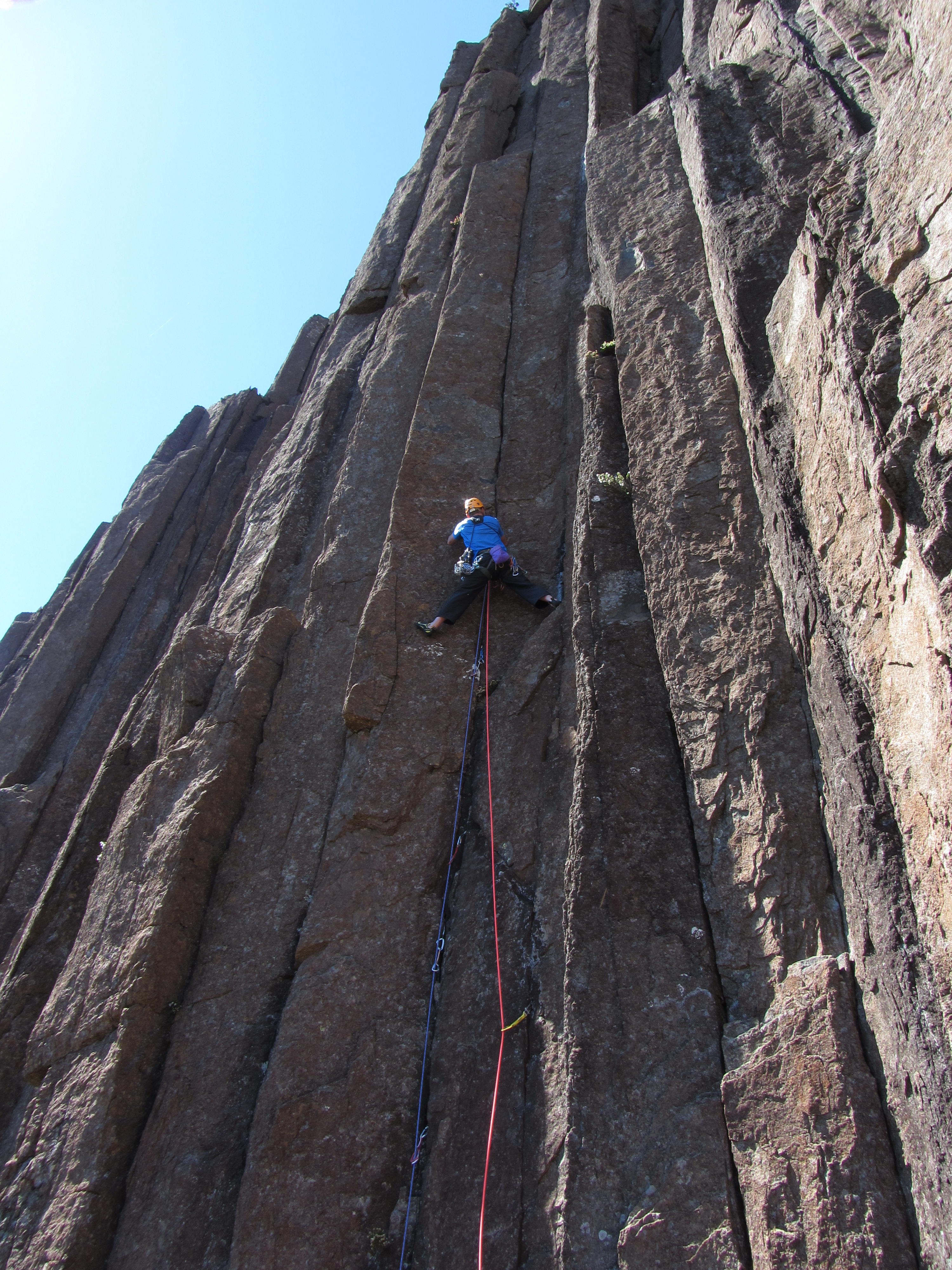
Gothic Line, pitch 1.
Roger half way up the first pitch of Gothic Line. The ledge 3 m left of him is the top of the first pitch of Ballyshannon. Photo: Ivan Riley.
Eastern Front
★70m20See Narkowicz guide.
Gerry Narkowicz, Rober McMahon; Dec 1984.
Bob and Doug's Second Route
70m18See Narkowicz guide.
Doug Bruce, Rober McMahon; Feb 1991.
Tirpitz
100m18See Narkowicz guide.
Steve Moon, Tim Carrol; Jan 1994.
Stranded Freighter
80m17See Narkowicz guide.
Steve Moon, Tim Carrol; Jan 1994.
Scourge of the Atlantic
80m19See Narkowicz guide.
Gerry Narkowicz, Greg Moore, Robert McMahon; Jan 1984.
Pologhda
★★60m21See Narkowicz guide.
Gerry Narkowicz, Robert McMahon; Dec 1984.
Panzer Breakout
★★60m20Robert McMahon, Gerry Narkowicz, Mick Ling, May 1982
Burning Bridges
60m21Bruce Cameron, Robert McMahon, Jan 1983
Battle of Britain
★60m20Neale Smith, Mick Ling.
Stalingrad Buttress
Bob and Doug's Route
18Robert McMahon, Doug Bruce, Feb 1991
Tailgunner
50m20Neale Smith, Mick Ling, Jan 1983
Kursk
★60m18Robert McMahon, Gerry Narkowicz, Jan 1983.
Danzig Corridor
★★★50m20Robert McMahon, Gerry Narkowicz, Nov 1983.
Nightmare in a Damaged Brain
45mStalingrad
★★47mA few meters of chimney at the bottom, and then a few face moves, lead to an excellent twin crack system. Takes loads of gear (esp hand-crack size but smaller and larger cams also). Good belay spot at about 35m if you're running low. Worth three stars despite a little loose stuff.
Bruce Cameron, Robert McMahon, Jan 1983.
Long Range Desert Group
★★45m15This goes up the big cleft in Stalingrad Buttress. Start about 3 m right of Stalingrad. It climbs well and is good fun on an interesting feature. Can be climbed as one pitch but there is a good belay ledge at about 8 m, where the hardest climbing is over.
Greg Moore, Gerry Narkowicz, Robert McMahon, Jan 1984.
Bomber Command
★★45m20Roger Parkyn & Steve Goss, Jan 2012.
Desert Fox
45m22This goes up the third crack (on the right of LRDG). Given two stars in Gerry's guide but it is very dirty and pro appears poor. There is a flat ledge at 32m. From the ledge go up the leftmost corner (hands/off-width; right of the flakey buttress).
Gerry Narkowicz, Robert McMahon, Bruce Cameron, Dec 1983.
Rommel
45m18Looks really dirty. A couple of meters right of DF.
Robert McMahon, Gerry Narkowicz, Greg Moore, Jan 1984.
Blitzkrieg Buttress
Dieppe
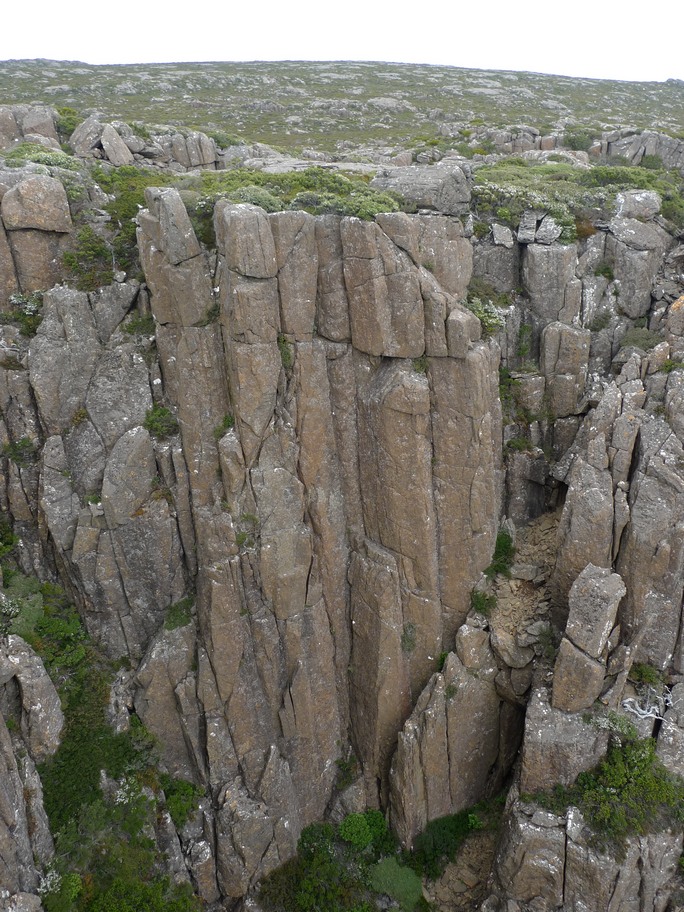
20m17Looking from Stalingrad Buttress you can see the wall which this route goes up the middle of: see the following pic. Might be good if it were clean; but it isn't.
Robert McMahon, Gerry Narkowicz, Jan 1983.
Bloodrunner
★★75m22With this and the next two routes it appears that the best is the top 35 m, which starts from the "Blitzkrieg Ledge". Blitzkreig Ledge can be reached easily enough on abseil (which looks a lot less work than the walk to the bottom described in the 2009 guide).[Comment by Roger: I don't know what the bottom pitch is like but the top one is a 3-star classic ... provided you like cracks. The ledge at the start of it can be reached with a 30m rap. Take lots of camalots 0.5-4 but especially red and gold (#1 and #2).
Mick Ling, John Fantini (alt), Jan 1984.
Blitzkreig
★★70 m21John Smart, Robert McMahon, 1981.
Howitzer
★★★75m22Gerry Narkowicz, Robert McMahon, John Fantini, Jan 1984.
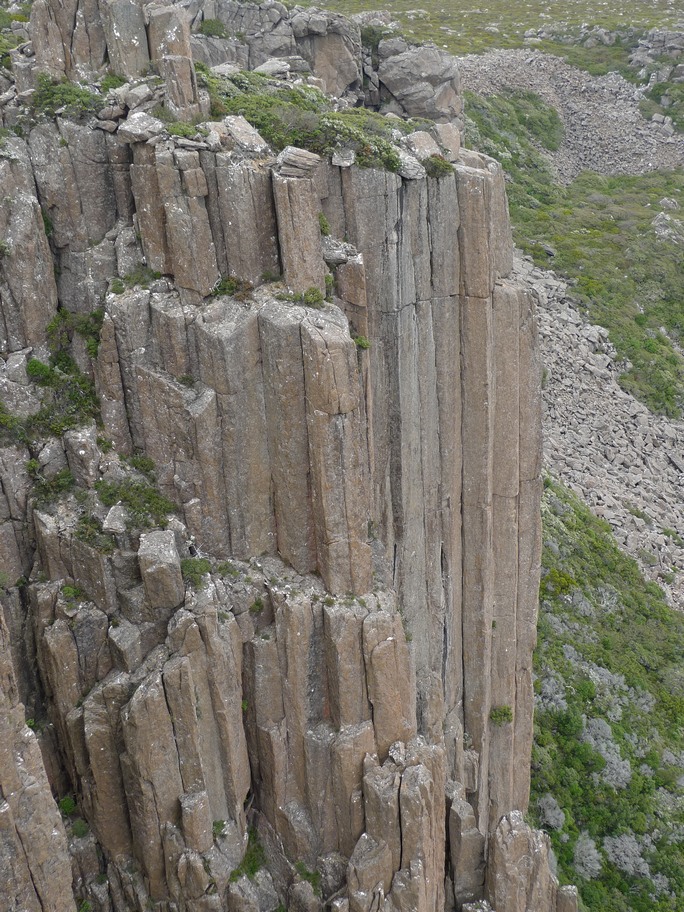
Viewed from Stalingrad Buttress. The line near the prow with the tree/shrub is Blitzkreig; Bloodrunner is to its left and Howitzer to its right.
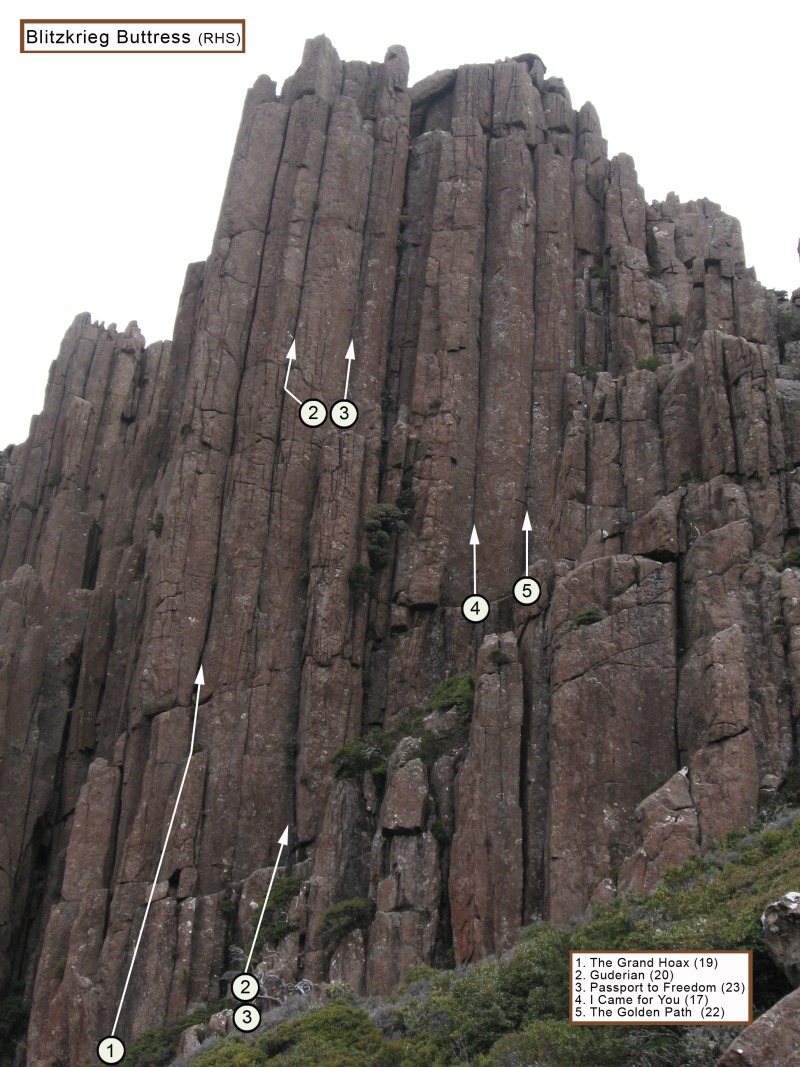
Andrew Geeves, Ben Veltkamp, Jan 2009.
Abseil to the ledge 5m above the gully. Superb face climbing with an occasional jam. Cruxy for the first 8m.
Ben Veltkamp, Andrew Geeves, Richard Halsey, Jan 2009.